
Cookie Scoop Sizes
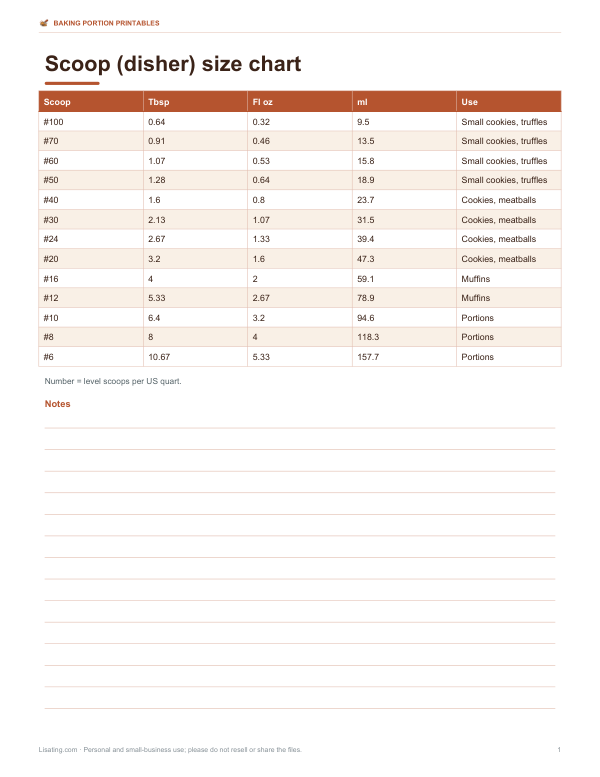
Cookie scoops and dishers are sized by a number — #40, #30, #20 — that means how many level scoops fill a US quart. This chart converts every common size into tablespoons, ounces and millilitres, suggests what each is good for, and the calculator tells you how many cookies, muffins or meatballs you’ll get from a batch with the scoop you have.
- Free to use
- No sign-up
- Runs in your browser
Quick answer
A 2 tbsp cookie scoop holds 1 US fl oz, or 29.6 ml. For cookie dough, that is typically about 30–36 g if the dough density is 1.0–1.2 g/ml. The exact gram weight varies by recipe. In disher sizing, an exact 2 tbsp scoop is #32; the common #30 scoop is slightly larger at about 2.13 tbsp.
Scoop size converter and batch calculator
Baking Portion Printables
Printable baking portion kit: a scoop size chart, a cookie yield and baking log, a muffin tin guide, a bake sale pricing sheet and recipe cards.
- Scoop chart (PDF)
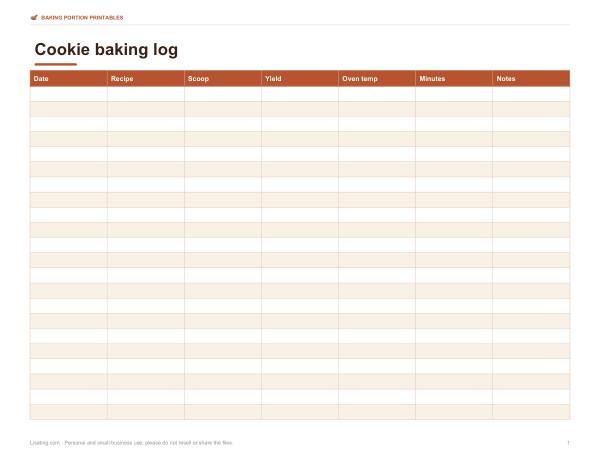
- Baking log (PDF, XLSX)
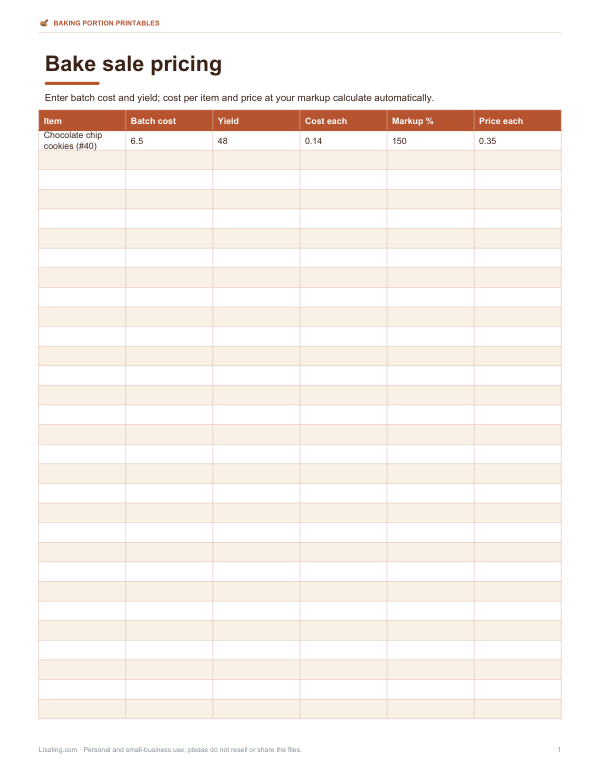
- Bake sale pricing (XLSX)
- Muffin tin guide (PDF)
Formats: PDF, XLSX. Instant download after payment (link valid 72 hours, up to 5 downloads). AI-assisted: the templates were drafted with AI help and reviewed and laid out before publishing.
$5.00 USD, one-time 4 files · about $1.25 each
- Instant download
- 7-day refund
- Secure checkout by Stripe
7-day money-back guarantee. Full refund within 7 days of purchase, even after you download.
Free sample: Bake Sale Pricing (PDF, 100 KB)
Full refund within 7 days — see the refund policy and license.
Free printables
Single sheets you can print right now, no sign-up. The full pack adds every sheet in one download plus the editable files.
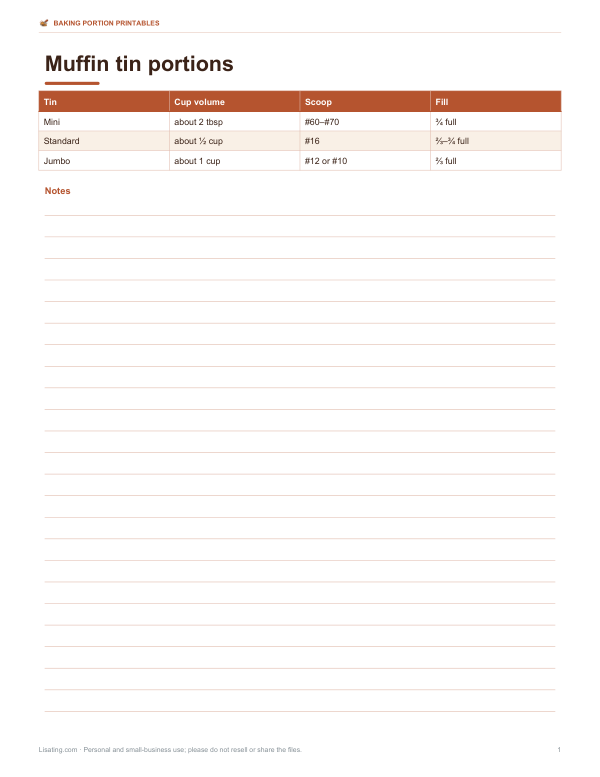 Printable Muffin Tin Portion Guide
Cookie scoop grams and millilitres
Gram weights are estimates for typical cookie dough at 1.0–1.2 g/ml; weigh your own dough for exact results.
| Scoop | Tablespoons | Millilitres | Typical grams | Notes |
|---|---|---|---|---|
| #70 | 0.91 | 13.5 | 14–16 g | Bite-size |
| #60 | 1.07 | 15.8 | 16–19 g | Small |
| #40 | 1.60 | 23.7 | 24–28 g | Standard |
| #32 | 2.00 | 29.6 | 30–36 g | Exact 2 tbsp |
| #30 | 2.13 | 31.5 | 32–38 g | Common medium |
| #20 | 3.20 | 47.3 | 47–57 g | Large |
| #16 | 4.00 | 59.1 | 59–71 g | ¼ cup |
| #10 | 6.40 | 94.6 | 95–114 g | 0.4 cup |
What the scoop number means
Portion scoops, also called dishers, are traditionally numbered by how many level scoops it takes to fill one US quart (32 fluid ounces, about 946 ml). So a #16 scoop holds 32 ÷ 16 = 2 fluid ounces — a quarter cup — and a #40 holds 0.8 fluid ounce, about 1.6 tablespoons. The bigger the number, the smaller the scoop. Many manufacturers also colour-code the handles, but colours are not standard between brands, so rely on the number.
Cookie scoop size chart
| Scoop | Tablespoons | Fluid ounces | Millilitres | Typical use |
|---|---|---|---|---|
| #100 | 0.64 | 0.32 | 9.5 | Truffles, tiny cookies |
| #70 | 0.91 | 0.46 | 13.5 | Bite-size cookies |
| #60 | 1.07 | 0.53 | 15.8 | Small cookies |
| #50 | 1.28 | 0.64 | 18.9 | Small drop cookies |
| #40 | 1.60 | 0.80 | 23.7 | Standard drop cookies |
| #30 | 2.13 | 1.07 | 31.5 | Standard to large cookies |
| #24 | 2.67 | 1.33 | 39.4 | Large cookies |
| #20 | 3.20 | 1.60 | 47.3 | Bakery-style cookies |
| #16 | 4.00 | 2.00 | 59.1 | Muffins (¼ cup) |
| #12 | 5.33 | 2.67 | 78.9 | Jumbo muffins (⅓ cup) |
| #8 | 8.00 | 4.00 | 118.3 | Side portions (½ cup) |
Values are for level scoops. A slightly rounded scoop holds roughly 10–20% more.
Why bakers use scoops
- Every cookie is the same size, so they bake evenly and finish at the same time.
- It’s faster than two spoons and less messy.
- Consistent portions make batch yields and costs predictable — important for bake sales and small businesses.
- Round, uniform dough balls give neat, round cookies.
How to use the calculator
- Choose your scoop number — it is usually stamped on the scoop’s blade or handle.
- Enter your batch size in cups, millilitres or grams of dough.
- For grams, adjust the dough density if needed — most cookie doughs are around 1.0–1.2 g per ml.
- Choose level or slightly rounded scoops.
- Read how many scoops the batch makes and how many baking sheets you need at 12 per sheet.
Worked example
A chocolate chip cookie recipe makes about 5 cups of dough. With a #40 scoop (23.7 ml, just over 1½ tablespoons) the batch gives about 50 level scoops — just over four baking sheets of 12. With a #20 scoop for bakery-style cookies the same dough makes about 25 cookies, and with a #16 scoop about 20, so plan on fewer, bigger cookies and a few extra minutes in the oven.
Baking tips for scooped cookies
- Leave about 2 inches between dough balls; bigger scoops need more space.
- Chill very soft dough for 30 minutes so it scoops cleanly and spreads less.
- Level the scoop against the side of the bowl for consistent portions.
- Larger cookies need a lower oven or longer bake — check the centre sets while the edges are golden.
- Rotate the tray halfway through for even colour.
Choosing a scoop
- Look for stainless steel with a squeeze or thumb-release mechanism that sweeps the bowl clean.
- Check the number stamped on the scoop rather than relying on a “medium” or “large” label.
- For stiff doughs, a sturdy spring and a comfortable grip matter more than size.
- A set of three — around #60, #40 and #20 — covers most home baking.
- Dishwasher-safe is convenient, but hand washing keeps springs working longer.
Freezing scooped dough
Scoop cookie dough onto a lined tray, freeze until firm, then store the balls in a freezer bag labelled with the scoop size, oven temperature and time. Bake straight from frozen, adding a minute or two. Portioned frozen dough means fresh cookies whenever you want a few.
Converting a recipe’s yield
Recipes often say “makes 24 cookies” without saying how big. If yours made far more or fewer, the recipe probably used a different scoop. Measure the dough in cups, then use the calculator to see which scoop gives the stated yield — and pick a scoop that gives the size you prefer. Remember to adjust baking time: bigger cookies need longer at the same temperature.
Beyond cookies
The same scoops portion muffin and cupcake batter (#16 for standard tins, #12 for jumbo), meatballs (#20–#40), melon balls and ice cream (#8–#16), mashed potatoes and rice for plated meals (#8), and energy balls or truffles (#60–#100). Food businesses use dishers to control portion costs.
Privacy
The calculator runs in your browser; nothing you enter is stored.
Frequently asked questions
How many grams is a 2 tbsp cookie scoop?
A 2 tbsp scoop is 29.6 ml. For typical cookie dough at 1.0–1.2 g/ml, that is about 30–36 grams, but the exact weight depends on the recipe.
Is a #30 scoop the same as 2 tablespoons?
Not exactly. A #30 scoop is about 2.13 tablespoons, while an exact 2 tablespoon disher would be #32.
45 g is how many ml for cookie dough?
For water, 45 g equals 45 ml. For cookie dough, 45 g is typically about 38–45 ml if the dough density is 1.0–1.2 g/ml.
What size is a #40 cookie scoop?
About 1.6 tablespoons (0.8 fl oz, 24 ml).
What size is a #20 scoop?
About 3.2 tablespoons (1.6 fl oz, 47 ml).
What does the number on a scoop mean?
How many level scoops fill a US quart.
What scoop size for muffins?
#16 (¼ cup) for standard muffins, #12 for jumbo.
What size is a tablespoon cookie scoop?
Roughly a #60 (about 1.07 tablespoons) or #70.
Are handle colours standard?
No, colours vary by brand — use the number.
How many tablespoons is a #30 scoop?
About 2.1 tablespoons (1.07 fl oz, 32 ml).
What scoop size for meatballs?
A #20 to #40 scoop, depending on how big you like them.
How do I convert a scoop size to cups?
Divide 4 by the scoop number: a #16 is ¼ cup, a #8 is ½ cup.
Why are my cookies different sizes?
Scoop level each time and chill soft dough so portions stay even.
Does scoop size change baking time?
Yes — bigger scoops need a few more minutes.